


Introduction
AI is no longer a "nice to have" line on a resume — it has become the deciding factor between two equally qualified candidates. Companies across every industry, from banking and healthcare to retail and media, are actively looking for people who can work alongside AI tools, not just people who know AI exists.
Recruiters today aren't just scanning for the word "AI" on a resume. They're looking for proof: Have you actually used these tools? Can you apply them to solve a real problem? Do you understand both the power and the limitations of AI?
This guide breaks down the most in-demand AI skills for 2026, explains why each one matters, and gives you concrete examples of how these skills show up in real jobs — so you know exactly what to learn and how to demonstrate it.
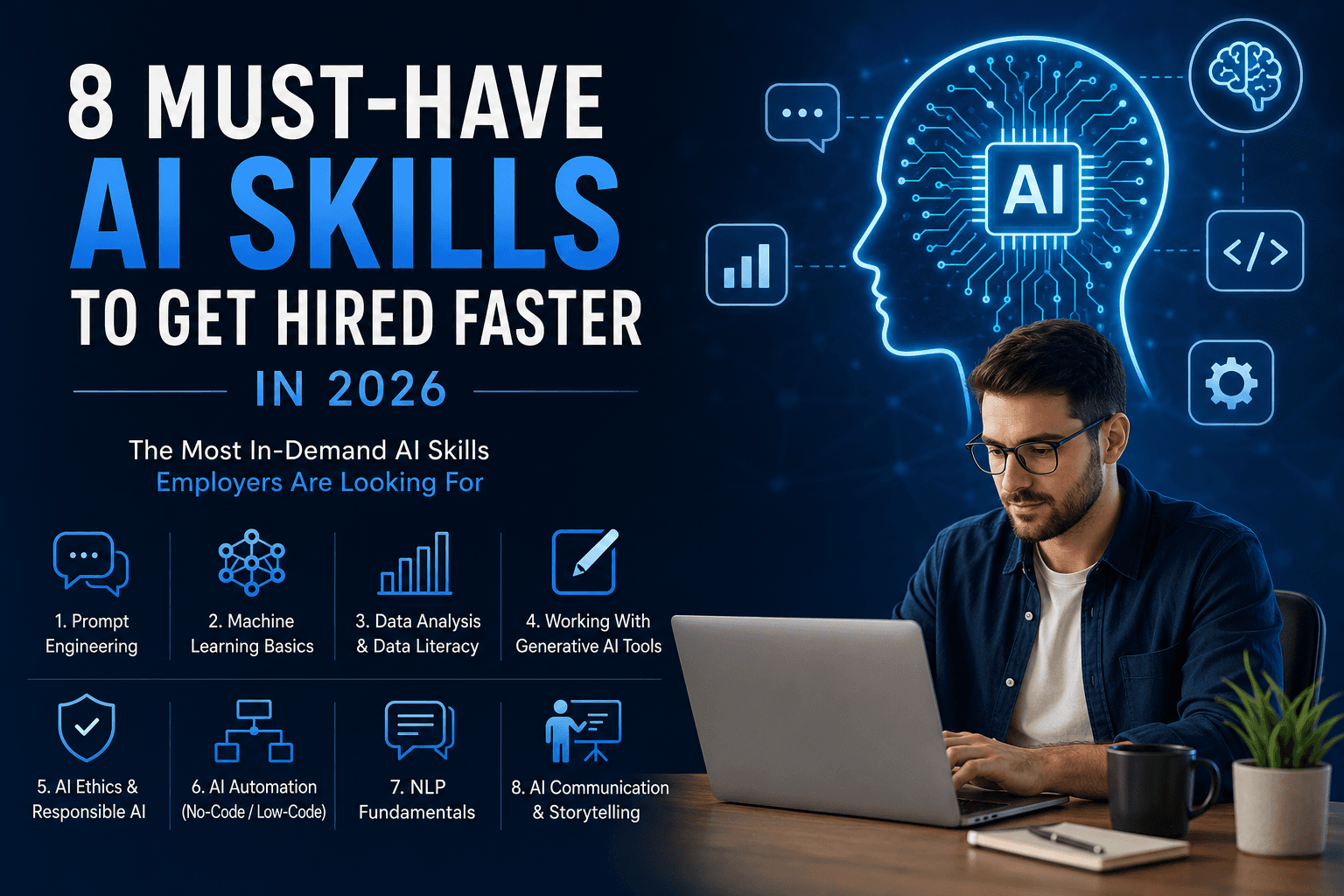
1. Prompt Engineering
Prompt engineering is the skill of communicating effectively with AI models like ChatGPT, Claude, and Gemini to get accurate, useful, and consistent outputs. It sounds simple, but there's a real skill gap between someone who types a vague question and someone who knows how to structure a prompt for a specific outcome.
Why it matters: Almost every knowledge-work role now touches an AI tool at some point — writing emails, summarizing reports, generating code, or brainstorming ideas. Employers want people who can get high-quality output on the first or second try, not the tenth.
Example in practice: A marketing executive at a company needs to create five different ad copy variations for a product launch. Instead of typing "write ad copy for my product," someone skilled in prompt engineering would write something like: "Act as a senior copywriter. Write 5 short ad variations (under 20 words each) for a noise-cancelling headphone targeting remote workers, in a witty and confident tone, and include one variation with a question hook." The difference in output quality is enormous.
How to build this skill:
- Practice writing prompts with clear role, context, task, format, and tone instructions
- Learn iterative prompting — refining an output over 2-3 follow-up messages instead of starting over
- Experiment across multiple AI models to understand their different strengths
2. Machine Learning Fundamentals
For technical roles — data analyst, ML engineer, data scientist — a working understanding of machine learning is non-negotiable. You don't need to build models from scratch every day, but you do need to understand how they work, what they need, and where they fail.
Why it matters: Even non-engineering roles increasingly involve reviewing ML outputs, testing model accuracy, or making decisions informed by predictive models. Understanding the fundamentals helps you ask the right questions and spot when something looks wrong.
Example in practice: An e-commerce company builds a model to predict which customers are likely to cancel a subscription. A candidate who understands ML fundamentals can look at the model's output and ask, "Is this model overfitting to last year's seasonal data?" — a question that immediately signals real understanding to an interviewer.
How to build this skill:
- Learn the difference between supervised, unsupervised, and reinforcement learning
- Get hands-on with Python libraries like scikit-learn, TensorFlow, or PyTorch
- Build 2-3 small projects: a spam classifier, a price predictor, or a recommendation system
3. Data Analysis and Data Literacy
AI systems are only as good as the data behind them, which means data literacy — the ability to read, clean, question, and interpret data — has become a foundational skill across almost every job function.
Why it matters: Whether you're in HR, finance, operations, or product, being able to look at a dataset and pull out a meaningful insight (instead of just a summary) makes you significantly more valuable.
Example in practice: An HR analyst is asked why employee attrition increased last quarter. Instead of just reporting "attrition went up 8%," someone with strong data literacy digs deeper: they segment the data by department, tenure, and manager, and discover that attrition is concentrated in one team under a specific manager — a much more actionable insight for leadership.
How to build this skill:
- Get comfortable with Excel, SQL, and Python's Pandas library
- Learn a visualization tool like Power BI or Tableau
- Practice turning raw numbers into a one-paragraph business insight, not just a chart
4. Working With Generative AI Tools
Generative AI tools — ChatGPT, Claude, Midjourney, DALL·E, GitHub Copilot, Claude Code — are now part of daily workflows across writing, design, marketing, and software development.
Why it matters: Employers expect candidates to already be comfortable using these tools to speed up their work. Someone who can produce a first draft, a design mockup, or a working code snippet in minutes using AI has a clear productivity edge.
Example in practice: A junior developer is asked to build a simple login page. Instead of writing every line manually, they use an AI coding assistant to generate the boilerplate code, then focus their time on reviewing, testing, and customizing the logic — cutting the task time significantly while still producing clean, working code.
How to build this skill:
- Use AI writing tools for real tasks: emails, reports, content drafts
- Use AI image tools for basic design and mockup work
- Use AI coding assistants for boilerplate code, debugging, and documentation
5. AI Ethics and Responsible AI Awareness
As AI gets embedded deeper into business decisions, companies are increasingly cautious about bias, privacy, and misuse. Candidates who understand responsible AI practices stand out, especially for roles touching customer data or automated decision-making.
Why it matters: A hiring manager doesn't just want someone who can build or use an AI system — they want someone who won't accidentally create a legal, ethical, or reputational problem for the company.
Example in practice: A company is building an AI tool to screen job applications. A candidate aware of AI ethics would flag that training the model only on past hiring data could carry forward historical bias against certain groups — a concern that shows maturity and real-world judgment, not just technical skill.
How to build this skill:
- Learn the basics of algorithmic bias, data privacy, and fairness in AI systems
- Understand data governance principles relevant to your industry
- Read case studies of AI failures (biased hiring tools, flawed facial recognition, etc.) to understand real risks
6. No-Code and Low-Code AI Automation
Not everyone needs to write code to use AI effectively. No-code and low-code automation tools let you build powerful workflows using AI without a programming background.
Why it matters: Many operations, marketing, and support roles now expect employees to automate repetitive tasks themselves instead of waiting on a developer team.
Example in practice: A customer support manager notices that 40% of incoming queries are repetitive password-reset requests. Using a no-code tool like Zapier or Make combined with an AI chatbot, they build a workflow that automatically resolves these queries — freeing up the team to focus on complex issues, without writing a single line of code.
How to build this skill:
- Learn automation platforms like Zapier, Make (Integromat), or n8n
- Build simple AI-powered chatbots or workflow automations for a real problem
- Practice mapping out a business process before automating it
7. Natural Language Processing (NLP) Basics
For those aiming for deeper technical AI roles, understanding NLP — how machines process and understand human language — is a high-demand, high-salary skill.
Why it matters: Almost every major AI product today, from chatbots to search engines to document summarizers, is built on NLP. Understanding it opens doors to specialized, well-paying roles.
Example in practice: A company wants to automatically categorize thousands of customer support tickets by topic and urgency. A candidate with NLP skills can build a text classification model that tags each ticket automatically, saving the support team hours of manual sorting every week.
How to build this skill:
- Learn core concepts: tokenization, sentiment analysis, text classification
- Understand how Large Language Models (LLMs) are trained and used
- Experiment with open-source tools like Hugging Face's model library
8. Communication and AI-Driven Storytelling
Technical skills alone aren't enough — the ability to explain AI-driven insights in simple, clear language to non-technical stakeholders is what turns good work into business impact.
Why it matters: A brilliant analysis that no one understands or acts on has no value. Employers want people who can bridge the gap between data/AI output and business decisions.
Example in practice: A data analyst builds a churn-prediction model with 92% accuracy. In front of leadership, instead of explaining the model's architecture, they say: "Right now, roughly 1 in 5 customers who show these three warning signs cancel within a month. If we target them with a retention offer, we could save an estimated $200,000 a year." That's the version that gets budget approved.
How to build this skill:
- Practice explaining technical findings in one or two plain-language sentences
- Learn basic data storytelling: lead with the insight, not the method
- Work on presentation and stakeholder communication skills
How to Actually Learn These AI Skills
- Structured courses: Start with free or low-cost certifications from Coursera, Google, Microsoft, or Udemy to build a foundation
- Hands-on projects: Build 3-5 small, real projects and put them in a portfolio — this matters far more than certificates alone
- Communities and networking: Join AI-focused communities on LinkedIn or Discord to stay current on tools and trends
- Daily practice: Use AI tools in your actual day-to-day work, not just in tutorials — real usage builds real fluency
Conclusion
AI is no longer a future skill — it's a present-day requirement. The professionals who invest time now in building practical, demonstrable AI skills will have a clear edge in every hiring pipeline over the next few years. You don't need to master all eight skills above at once. Pick two or three that align with your career goals, build real examples you can talk about in interviews, and start applying them in your current work today. That's what will actually set you apart and get you hired faster.