


Introduction
Hiring the right candidate used to mean recruiters spending hours — sometimes days — sifting through hundreds of resumes for a single job opening. Today, that process looks completely different. Artificial Intelligence (AI) has stepped in to handle the repetitive, time-consuming parts of recruitment, allowing HR teams to focus on what really matters: building relationships with the right talent.
From scanning resumes in seconds to predicting which candidates are most likely to succeed in a role, AI has become an essential part of the modern hiring toolkit. In this blog, we'll break down exactly how recruiters use AI to shortlist candidates, the technologies behind it, and what this means for both employers and job seekers.
1. Automated Resume Screening
The most common use of AI in recruitment is resume screening. Instead of manually reading every application, recruiters use AI-powered Applicant Tracking Systems (ATS) that scan resumes for:
- Relevant skills and keywords
- Years of experience
- Educational qualifications
- Certifications and past job titles
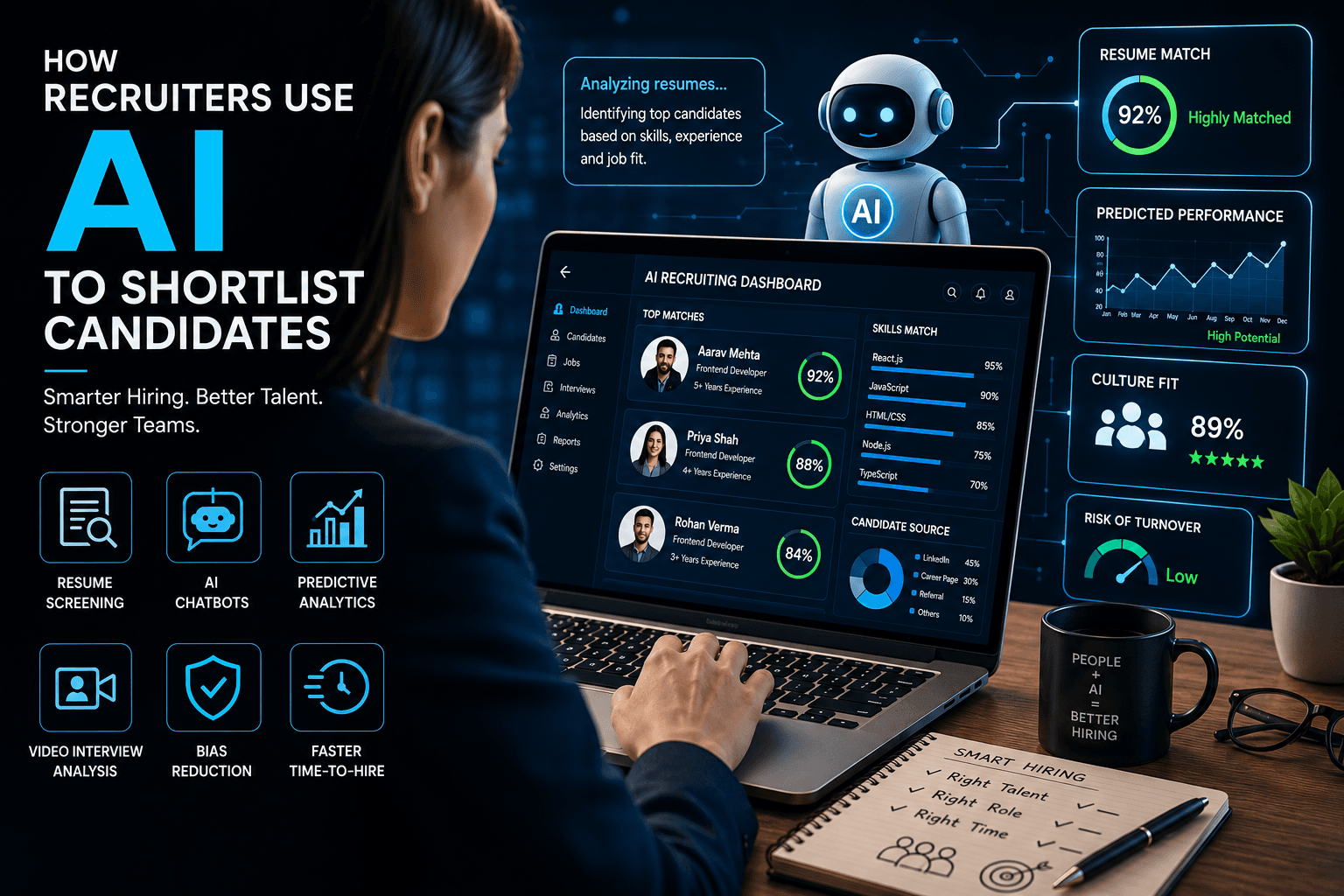
These systems compare each resume against the job description and generate a match score, helping recruiters instantly identify the most qualified candidates without opening a single PDF manually.
Popular tools: Workday, Greenhouse, Zoho Recruit, and LinkedIn Recruiter all use AI-driven screening features.
2. Natural Language Processing (NLP) for Deeper Understanding
Basic keyword matching isn't enough anymore. Modern AI recruiting tools use Natural Language Processing (NLP) to understand context, not just words.
For example, NLP can recognize that "led a team of five developers" implies leadership experience, even if the word "leadership" never appears in the resume. This allows AI to:
- Understand synonyms and related skills (e.g., "React.js" and "Frontend Development")
- Detect seniority level based on language and responsibilities described
- Identify transferable skills from unrelated industries
This makes shortlisting far more accurate than traditional keyword-based filtering.
3. AI Chatbots for Initial Candidate Screening
Many companies now use AI-powered chatbots to conduct the first round of candidate interaction. These bots can:
- Ask pre-set screening questions (availability, salary expectations, work authorization)
- Answer candidate FAQs about the role or company
- Schedule interviews automatically based on recruiter and candidate availability
- Flag candidates who meet minimum requirements for human review
This reduces the manual back-and-forth of emails and calls, speeding up the early stages of hiring significantly.
4. Predictive Analytics and Candidate Scoring
One of the most powerful applications of AI in recruitment is predictive analytics. By analyzing historical hiring data — such as which employees performed well, stayed longer, or were promoted — AI models can predict how likely a new candidate is to succeed in a similar role.
Recruiters use this to:
- Rank candidates by predicted job performance
- Identify flight risk (likelihood of leaving early)
- Prioritize candidates with the highest potential culture fit
This data-driven approach helps reduce hiring mistakes and improves long-term retention.
5. AI-Powered Video Interview Analysis
Some companies use AI to analyze recorded video interviews. These tools can assess:
- Word choice and communication clarity
- Tone and confidence levels
- Response relevance to interview questions
While this technology is powerful, it's also one of the more debated uses of AI in hiring, as critics raise concerns about bias and the risk of over-relying on automated judgment for something as nuanced as human communication.
6. Bias Reduction — When Used Correctly
A well-designed AI system can actually help reduce unconscious human bias in hiring by:
- Removing personal identifiers like name, gender, or photo during initial screening (a process called blind hiring)
- Standardizing evaluation criteria across all candidates
- Focusing purely on skills and experience data
However, it's important to note that AI is only as unbiased as the data it's trained on. If historical hiring data contains bias, the AI can unintentionally learn and repeat it. That's why responsible companies regularly audit their AI hiring tools for fairness.
7. Faster Time-to-Hire
Ultimately, all of these AI applications lead to one major benefit: speed. Companies using AI in recruitment report significantly shorter hiring cycles because:
- Resumes are pre-filtered instantly instead of manually
- Scheduling is automated
- Only the most relevant candidates reach human recruiters
This means top candidates are less likely to be lost to competitors during a slow hiring process.
The Human Element Still Matters
It's important to remember that AI is a tool to assist recruiters, not replace them. Final hiring decisions — especially those involving culture fit, soft skills, and long-term potential — still rely heavily on human judgment. The best hiring strategies combine AI's speed and data-processing power with a recruiter's emotional intelligence and experience.
Conclusion
AI has fundamentally changed how recruiters shortlist candidates — making the process faster, more consistent, and often more accurate. From resume screening and chatbots to predictive analytics and bias reduction, AI tools are helping companies find the right talent in a fraction of the time it used to take.
As this technology continues to evolve, the recruiters who succeed will be those who know how to use AI as a powerful assistant — while still keeping human judgment at the heart of every hiring decision.